What Do Employees Actually Need From Financial Wellness Programs for Women's ERGs?
Written by Lisa Y. Jones
Last updated: October 25, 2026

Financial Wellness Workshops for Women's ERGs: 5 Key Topics
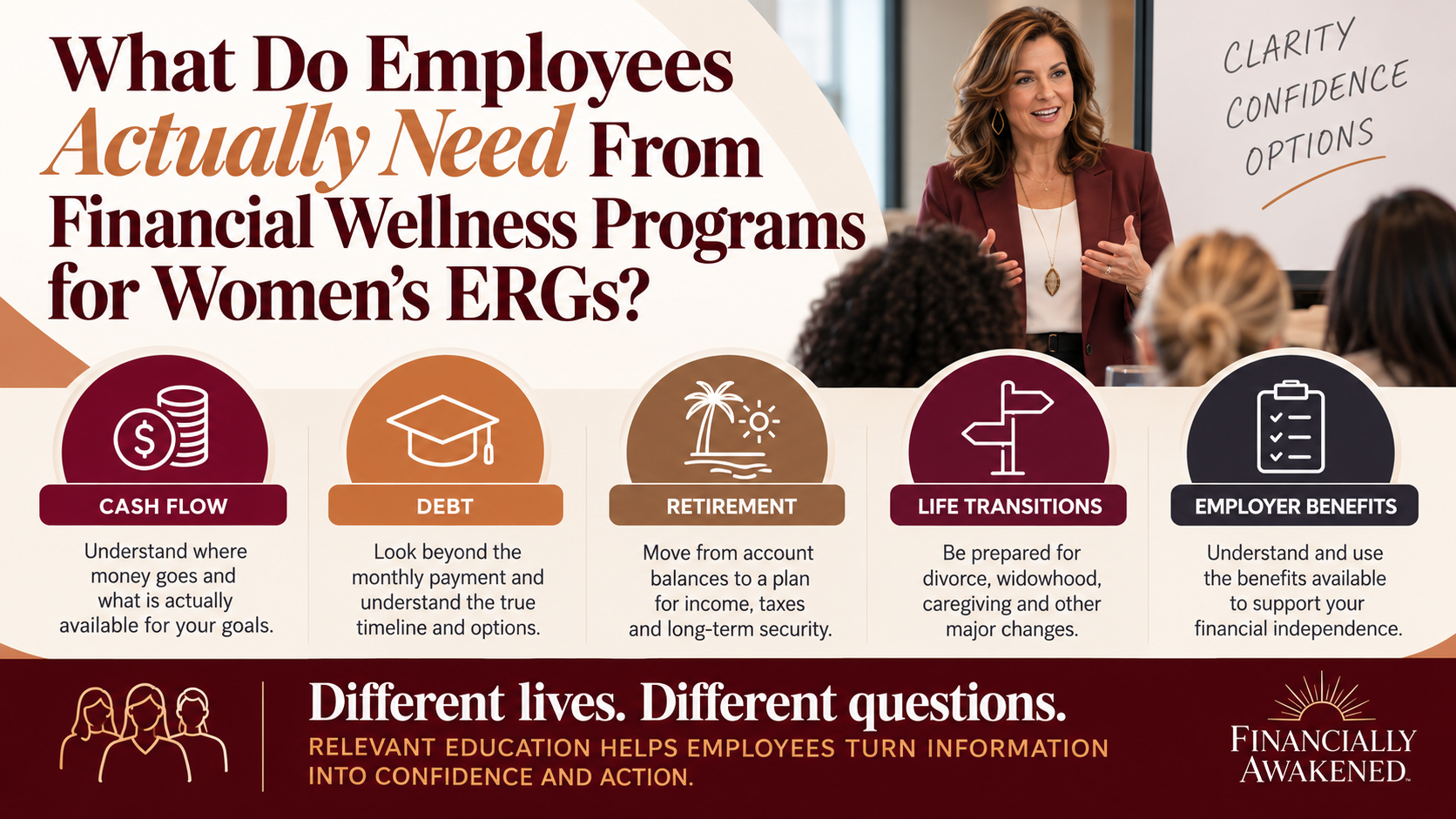
Employees in women's Employee Resource Groups (ERGs) need financial wellness education that reflects the decisions they actually face: managing cash flow, reducing debt, preparing for retirement, navigating financial transitions, and protecting their financial independence. Effective programs provide practical tools, relevant examples, confidential participation, and opportunities for follow-through rather than another generic lecture about budgeting and saving money.
Think about what employees actually take away from the session. Perhaps one woman finally understands why her student loan balance has barely moved despite years of payments. Another begins to recognize that having a substantial retirement account does not necessarily mean she has a plan for generating retirement income. Someone else may realize that her financial stress has less to do with how much she earns and more to do with how much of her income is already committed. Those discoveries can create opportunities for meaningful change, but they rarely happen when financial wellness is treated as another presentation to check off the corporate calendar.
For women's ERGs, the opportunity is to create financial education that goes beyond sharing information and begins helping employees connect that information to their own financial lives.
Why Traditional Financial Wellness Programs Often Miss the Mark
Many workplace financial education programs start with the basics. Create a budget. Save for emergencies. Contribute to retirement. Avoid unnecessary debt.
There is nothing inherently wrong with those topics. The problem is assuming that everyone needs the same lesson or that knowing what to do automatically means someone knows how to apply it to her circumstances.
Consider a woman earning $150,000 a year. She may already contribute to her 401(k), own a home, and maintain a successful career. A presentation encouraging her to start saving 10% of her income may offer very little new information.
But what if she doesn't know when her student loans will actually be paid off? What if she has accumulated $750,000 in retirement savings but has no idea how that money will translate into income? Or perhaps she is approaching retirement while financially supporting an aging parent, and she is beginning to wonder how those responsibilities will affect her future.
Now we have conversations worth having.
The Consumer Financial Protection Bureau's research on effective financial education emphasizes that education should account for people's circumstances, provide relevant and timely information, build useful skills, and make it easier to follow through.
That reinforces something I have found important in financial coaching. Information is valuable, but understanding how it applies to your own life is what makes it useful.
High Income Does Not Automatically Mean Financial Security
One of the assumptions about professional women is that a strong salary means their financial lives are already in good shape. While that may be true for some, income alone doesn't tell us much about someone's financial responsibilities, obligations, or confidence in her financial future.
A woman can earn six figures while carrying significant student loan debt, supporting aging parents, helping adult children, and managing a household on a single income. She may have accumulated substantial retirement savings without understanding how to turn those assets into income when she stops working.
She may be doing exceptionally well professionally while privately wondering whether her money is working as hard as she is.
The Federal Reserve's 2026 report on the economic well-being of U.S. households found that 59% of adults experienced at least one major unexpected expense during the previous 12 months. Only 35% of non-retirees reported that their retirement savings were on track.
Those figures describe U.S. adults broadly, not women in ERGs specifically. However, they illustrate why employers cannot assume that having access to income, benefits, or a retirement account automatically creates financial confidence.
This is why I believe effective financial wellness education should look beyond salary and explore how much financial control, flexibility, and confidence employees actually have.
What Financial Wellness Topics Do Women Employees Actually Need?
The answer depends on the people sitting in the room.
An early-career professional, a recently divorced executive, a single mother, and a woman five years from retirement may all belong to the same ERG. Their financial priorities may have very little in common, even when they work for the same employer and have access to the same benefits.
That doesn't mean every employee needs a completely different program. It means a strong program should address the decisions that matter across different financial seasons.
1. Cash Flow: Where Does My Money Actually Go?
For many professionals, the issue isn't necessarily earning more money. It's understanding how much of their existing income is already committed before they have an opportunity to make other financial decisions.
Taxes, housing, transportation, student loans, insurance, family responsibilities, and lifestyle expenses can consume a significant portion of take-home pay. Individually, those obligations may seem completely manageable. The difficulty comes when all those affordable decisions have to coexist inside the same paycheck.
A practical cash-flow workshop can help employees identify their fixed obligations, account for expenses that do not occur every month, and determine what is truly available for debt reduction, saving, investing, or other goals.
Rather than focusing exclusively on what employees should stop buying, the conversation becomes an opportunity to explore how their financial commitments affect their choices.
Income is what you earn. Margin is what you control.
For a high-income professional who has never examined that distinction, it can completely change how she views her financial situation.
2. Debt: Can I Afford the Timeline, Not Just the Payment?
Debt education is often reduced to a discussion of interest rates, credit scores, and making payments on time. While those concepts matter, many high-income earners are already making their payments without difficulty. Their concern may be that the debt never seems to disappear.
Imagine a 48-year-old professional with $125,000 in student loans. Her monthly payment fits comfortably within her income, so the debt doesn't feel particularly urgent. But she has never calculated how old she will be when the final payment is made.
If she wants to retire at 62, discovering that her current repayment strategy extends well beyond that date could change how she approaches several other financial decisions.
A meaningful financial wellness session helps employees understand their projected payoff dates, the cost of maintaining existing debts, and the opportunities that could emerge as payments are eliminated.
It also recognizes that employees with federal student loans may have forgiveness options worth evaluating before accelerating repayment.
Instead of simply encouraging employees to pay more toward debt, the conversation focuses on understanding where their current strategy leads and whether that destination aligns with their goals.
3. Retirement: Am I Accumulating Money or Preparing for Income?
Most employers provide information about their retirement plans. Employees can often learn how to enroll, increase contributions, choose investments, or access educational resources from the plan administrator.
Those are valuable benefits, but understanding how to contribute to a retirement account and understanding how to live on those assets are two very different things.
An employee may know that she has accumulated $800,000 in her retirement account without knowing how much monthly income those assets might reasonably support. She may have questions about taxes, market downturns, healthcare costs, or whether her retirement savings will last as long as she does.
These questions become especially important for women approaching retirement on a single income. Without a spouse's income or retirement benefits to share household expenses, the impact of certain decisions may be greater.
According to the U.S. Department of Labor's Women's Bureau, caregiving responsibilities, income differences, and the financial realities of aging can affect women's long-term retirement security.
A retirement-focused ERG workshop can complement the employer's existing benefits education by helping employees understand how their retirement accounts fit into their broader financial picture.
The conversation moves beyond how much someone has accumulated and begins exploring what that money is expected to accomplish.
4. Financial Transitions: What Happens When Life Changes?
Some of the most consequential financial decisions happen when life doesn't go according to plan.
An employee gets divorced after 25 years of marriage. Another loses her spouse and suddenly becomes responsible for financial decisions they previously made together. Someone else finds herself helping an aging parent whose care needs are becoming more expensive.
For others, a medical diagnosis, unexpected career change, or loss of household income can quickly alter financial priorities that once seemed settled.
These transitions may involve insurance, emergency reserves, debt, beneficiaries, retirement accounts, and long-term financial planning. They can also create uncertainty for employees who have been financially successful but have never had to navigate that particular situation.
Traditional workplace financial education doesn't always make room for these conversations, even though they may be among the most relevant topics employees face.
A financial wellness session focused on life transitions can help participants understand which questions to ask, what resources may be available, and which areas of their financial lives might deserve closer attention.
The objective isn't to prepare employees for every possible emergency. It's to help them recognize that their financial strategies may need to evolve as their circumstances change.
5. Employee Benefits: Am I Actually Using What My Employer Provides?
An employer can offer excellent benefits that employees don't fully understand.
Life insurance, disability coverage, retirement contributions, health savings accounts, employee assistance programs, and voluntary benefits can all play a role in an employee's financial life. However, enrolling in a benefit and understanding what that benefit actually does are not necessarily the same thing.
For example, an employee may have group life insurance through her employer but have never considered whether that coverage would adequately support her dependents. Another may contribute to a retirement account without fully understanding her employer's matching formula or the available contribution options.
A thoughtful financial wellness program helps employees ask better questions about their benefits and recognize when workplace coverage should be reviewed alongside their personal financial circumstances.
This education should complement, rather than replace, the official benefits information supplied by the employer and its plan providers.
Consider a Women's ERG Planning Its Next Financial Wellness Event
Imagine you are leading a women's ERG at an organization with several thousand employees, and you've been asked to schedule a financial wellness session.
You could invite someone to deliver a presentation called Five Steps to Financial Success. It sounds reasonable, covers familiar topics, and might attract a good audience.
But consider three women who might attend.
The first is a 35-year-old manager earning $110,000. She has student loans, pays for childcare, and wants to buy a home. She would benefit from understanding how her competing obligations affect her ability to build savings and prepare for a significant purchase.
The second is a 52-year-old director earning $165,000. She is single, supports an aging parent, and has built substantial retirement savings. Her biggest concern isn't learning how to start investing. She wants to understand whether she can retire before 65 without compromising her financial security.
The third is a 61-year-old federal employee preparing to retire. She has accumulated money in her TSP but is uncertain how her pension, Social Security, TSP withdrawals, and taxes will work together once her paycheck stops.
All three are accomplished professionals who could benefit from financial education, but their questions are very different. A generic presentation may provide some useful information, yet fail to address the decisions that matter most to any of them.
Now imagine offering a workshop called:
"You Earn Good Money. But Is Your Money Giving You Options?"
Instead of beginning with budgeting rules, you invite employees to consider how much of their income they control, which financial commitments may be limiting their choices, and what decisions deserve more attention.
The session uses scenarios that reflect different career and life stages. Participants work through a short assessment privately and leave with one financial question they want to investigate further.
That experience is much more likely to feel relevant than assuming everyone needs another reminder to save money.
These are hypothetical examples illustrating different employee needs.
What Makes a Women's ERG Financial Wellness Workshop Worth Attending?
The best topic in the world won't create much value if the delivery makes employees uncomfortable or leaves them unsure what to do afterward.
I believe an effective workshop should feel less like a financial lecture and more like a conversation that helps participants recognize something they may have overlooked in their own financial lives.
That can include scenario-based discussions, simple worksheets, anonymous questions, and practical exercises that employees can complete without sharing sensitive personal information.
Privacy is particularly important when discussing money in the workplace. Employees should never feel pressured to disclose their salaries, debts, retirement balances, marital situations, or other personal financial information in front of coworkers.
It is also important to distinguish education from a product presentation. Employees should understand whether a speaker is providing financial education, offering coaching services, or discussing financial products. Any commercial relationships or potential conflicts of interest should be clearly disclosed.
And the experience doesn't necessarily have to end when the workshop does.
A worksheet, follow-up resource, or optional educational session can help employees continue exploring what they learned. The goal isn't to overwhelm participants with every possible financial strategy. It's to help them identify a useful next step and understand why it matters.
How Can HR Leaders Measure Whether Financial Wellness Education Works?
Attendance matters, but I wouldn't make it the only measure of success.
A room filled with employees tells you that people were interested enough to attend. Positive evaluations may indicate that they enjoyed the speaker or appreciated the topic. Neither automatically tells you whether the education improved their understanding or helped them make a meaningful decision.
A more useful evaluation considers whether participants understood the material, gained confidence, identified a relevant action, or used the resources available afterward.
For example, an anonymous post-session survey might ask whether employees better understand their financial options, whether the session addressed a concern they were already experiencing, and whether they have identified a next step they feel prepared to take.
The Consumer Financial Protection Bureau provides employer resources that include tools for evaluating financial well-being. Its Financial Well-Being Scale can also support more structured measurement over time when appropriately administered.
Any reporting to an employer should protect individual privacy and avoid exposing employees' personal financial circumstances. Aggregated, voluntary feedback is generally more appropriate than collecting identifiable financial information.
The objective isn't to promise that one workshop will immediately improve productivity or retention. It's to determine whether the education is helping employees move from uncertainty toward understanding and action.
What This Means for You as an ERG or HR Leader
If you're responsible for women's programming, employee engagement, learning and development, or benefits education, your next financial wellness event presents an opportunity to do more than fill a calendar.
Consider who your employees are and what financial decisions they may currently be facing. Some may be struggling with debt despite strong salaries, while others are supporting both children and aging parents. You may have employees navigating divorce or widowhood, along with others approaching retirement who have never calculated how much income their savings may provide.
When you begin with those realities, the conversation changes.
Instead of asking, "What financial topic should we present this quarter?" you can begin asking, "What financial decisions are our employees trying to make, and what information would help them make those decisions with greater confidence?"
You may discover that the most valuable workshop isn't the one covering the greatest number of financial topics. It's the one that addresses a concern employees recognize immediately and provides them with something useful they can apply.
There is also no reason to solve every financial challenge in a single session. A series of focused workshops can offer more value than an annual event that attempts to cover everything.
Cash flow could be one conversation, followed by debt and payoff timelines. Retirement readiness, financial protection, or major life transitions could become subsequent topics. Employees could then participate in the sessions most relevant to their current circumstances.
Over time, that approach can create a financial education experience that feels less like a corporate requirement and more like a resource employees genuinely appreciate.
Your Next Step: Create Financial Wellness Education Employees Can Use
At Financially Awakened, we approach financial wellness through both the practical and behavioral sides of money.
My husband, Keith, and I paid off more than $300,000 in debt in five years. That experience reinforced something that continues to shape the way we teach today: financial progress is not determined by income alone, and knowing the right financial concept doesn't automatically translate into changing financial behavior.
Through Financially Awakened, we offer corporate financial education, employee resource group programming, workshops, self-paced learning, and coaching solutions that can be tailored to an organization's needs.
Whether your team is focused on debt, cash flow, retirement readiness, financial decision-making, or navigating life transitions, we can explore an educational approach that fits the people you serve.
A successful financial wellness program should leave employees with more than good notes and an enjoyable afternoon. It should help them better understand their financial situations, recognize their options, and identify decisions that could move them closer to their goals.
The goal is not simply to teach employees about money. It's to help them understand what their money can make possible.
DISCUSS A FINANCIAL WELLNESS PROGRAM FOR YOUR WOMEN'S ERG
Frequently Asked Questions
-
A women's ERG financial wellness program can include education about cash flow, debt management, retirement readiness, employer benefits, financial protection, and major life transitions. The most valuable topics depend on employees' needs, career stages, and financial responsibilities. Programs should offer relevant examples and practical next steps rather than relying exclusively on general financial advice.
-
Financial wellness education can complement an employer's existing benefits and support employees as they navigate important financial decisions. Programs tailored to women's experiences can address issues such as caregiving, retirement security, financial independence, and major life transitions without assuming every woman has the same needs or circumstances.
-
High-income women may benefit from discussions about financial margin, substantial debt, retirement income, taxes, liquidity, and protecting their financial independence. Rather than assuming that a six-figure salary eliminates financial concerns, workshops can explore how income and existing financial commitments affect long-term flexibility and decision-making.
-
Relevant scenarios, anonymous questions, interactive exercises, and useful take-home tools can make financial education more engaging. Employees should be able to participate without disclosing personal financial information publicly.
The strongest sessions connect financial concepts to decisions participants recognize in their own lives and provide opportunities to apply what they learn.
-
Employers can evaluate participation, employee feedback, changes in financial confidence, and self-reported next steps. The Consumer Financial Protection Bureau also offers a Financial Well-Being Scale that organizations can use to evaluate financial well-being more systematically.
Individual responses should be handled confidentially, with organizational reporting focused on appropriate aggregated information.
-
A single workshop can introduce a valuable financial concept, but an ongoing series allows different topics to receive more attention. A series covering cash flow, debt, financial transitions, retirement, and benefits can also help employees engage with subjects most relevant to their circumstances.
Organizations can begin with one focused session and use employee feedback to determine which subjects deserve further exploration.
About Lisa Y. Jones
Lisa Y. Jones is a wealth strategist, financial educator and #1 best-selling author of Financial Seasons. Through Financially Awakened, she helps high-income professionals understand how cash flow, debt and financial decisions work together so they can move from earning good money to actually controlling more of it.
This article is provided for educational purposes only and does not constitute individualized financial, investment, tax, or legal advice. Financial education programs should be designed around organizational needs, applicable requirements, and appropriate participant privacy safeguards.