I Make $150,000 a Year. Why Am I Still Living Paycheck to Paycheck?
Written by Lisa Y. Jones
Last updated: September 2026

If you make $150,000 a year and still feel like you are living paycheck to paycheck, the problem may not be that you do not make enough money. Your income may already be committed to taxes, housing, debt, transportation, family obligations, lifestyle costs and expenses that do not happen every month.
A six-figure salary creates income.
It does not automatically create financial margin.
And that distinction matters.
You can have a successful career, earn more than you ever expected to earn, contribute to retirement and still wonder:
Where is all my money going?
This is not only a low-income problem. You might be earning $125,000, $150,000 or $200,000 and still have very little control over what remains each month.
The better question is not simply:
Am I spending too much?
It is:
How much of my income is actually available for me to make decisions with?
$150,000 of Income Is Not $150,000 of Spendable Money
Your gross salary is not the amount deposited into your bank account.
Income-tax withholding, retirement contributions, health insurance and other payroll deductions all affect the amount available to fund your monthly life.
The IRS explains that employers generally withhold federal income tax from an employee’s paycheck, although the amount withheld remains part of the employee’s gross income for tax purposes.
Source: IRS, Topic No. 401: Wages and Salaries
Then your take-home pay has to support your actual life.
That may include:
Mortgage or rent
Car payments
Student loans
Credit cards
Insurance
Utilities
Groceries
Travel
Family support
Home repairs
Medical expenses
Gifts and holidays
Professional expenses
Saving and investing
Suddenly, “I make $150,000” and “I have plenty of money available every month” are two very different statements.
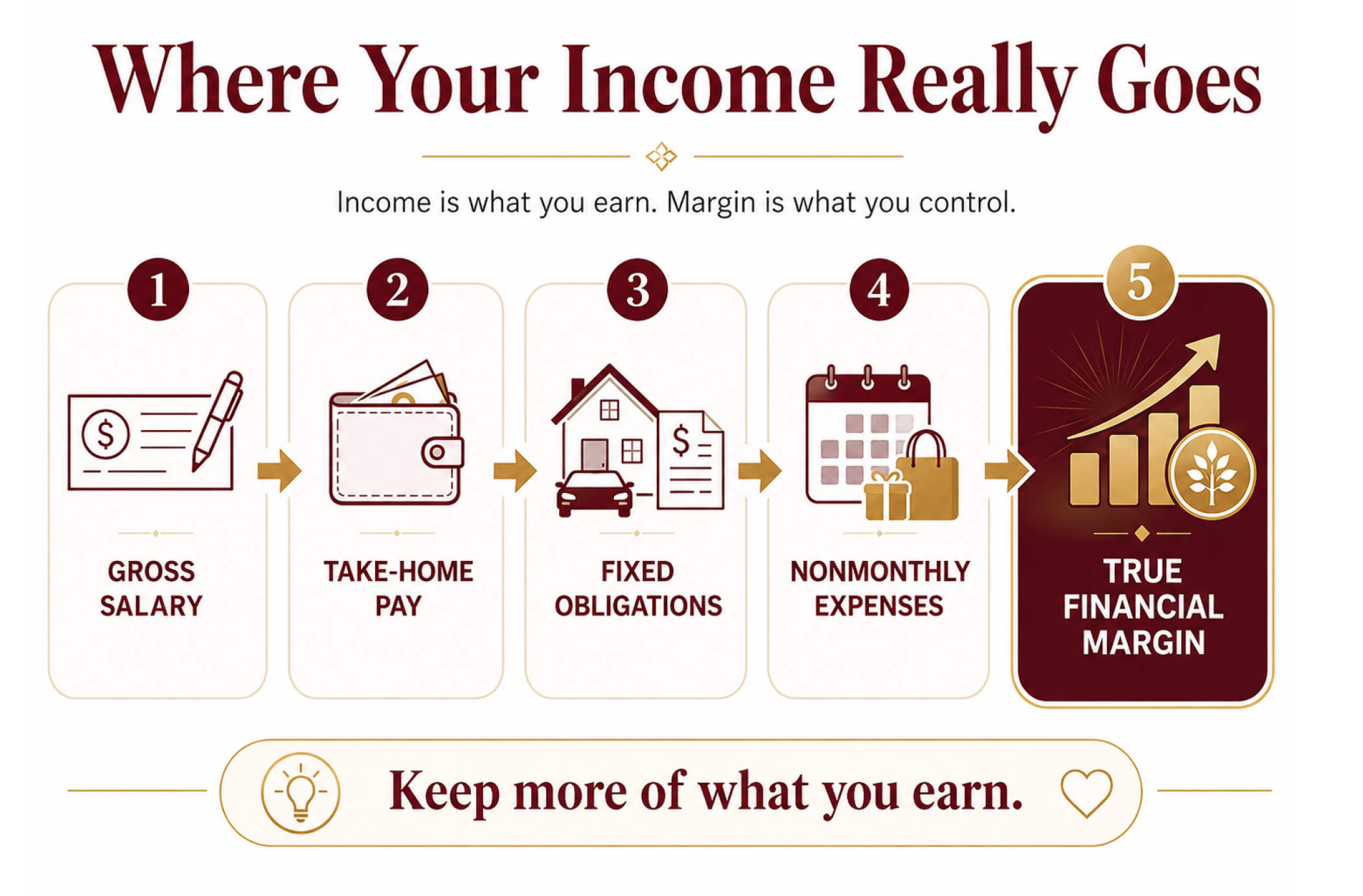
Gross salary → Take-home pay → Fixed obligations → Nonmonthly expenses → True financial margin
That last number is the one that determines how much financial flexibility you really have.
The Real Problem: Too Much of Your Income May Already Be Assigned
This is where many high-income earners get stuck. Individually, your financial decisions may look completely affordable. The mortgage is affordable. The car payment is affordable. The student loan payment is affordable. Travel is affordable. The subscriptions are affordable.
The issue appears when all of the affordable decisions have to coexist inside the same paycheck. By the time your income arrives, much of it may already belong somewhere else.
That leaves very little room for the decisions you want to make next.
Five Reasons You Can Make Six Figures and Still Feel Broke
1. You Are Managing Your Finances by Payment Instead of Total Obligation
High earners can qualify for a lot.
But being able to afford a monthly payment does not necessarily mean that obligation fits comfortably into your larger financial life.
A $700 car payment may be manageable.
A $3,000 mortgage may be manageable.
Your student loan payment may be manageable.
The problem is the cumulative effect.
Instead of asking only:
Can I afford this payment?
Ask:
How much of my future monthly income is already committed because of decisions I have made?
That gives you a much clearer picture.
2. Debt Is Consuming Tomorrow’s Income
Debt does more than create a monthly bill.
It creates a claim on income you have not earned yet.
Every future paycheck already has to send money toward yesterday’s purchases, student loans, vehicles or credit-card balances.
That is why increasing your income does not always create the financial freedom you expected.
Your income may have increased.
But your obligations increased with it.
3. Nonmonthly Expenses Keep Catching You Off Guard
Some expenses do not happen every month, but they are still part of your life.
Christmas comes every year.
Cars need maintenance.
Homes need repairs.
Professional licenses renew.
Insurance premiums come due.
Trips happen.
Medical expenses happen.
According to the Federal Reserve’s 2026 report on household financial well-being, 59% of adults experienced at least one major unexpected expense during the previous 12 months.
Source: Federal Reserve, Economic Hardships
If these expenses are not accounted for in your financial plan, every unusual month can feel like an emergency.
And when cash flow cannot absorb the expense, the credit card often becomes the temporary solution.
Then next month’s income has another job.
It has to pay for last month’s life.
4. Your Lifestyle Increased Quietly as Your Income Increased
Lifestyle creep does not always look extravagant.
It can be:
A nicer neighborhood
A newer car
More DoorDash
Better travel
Upgraded subscriptions
Convenience spending because your career is demanding
Paying for services you once handled yourself
None of those choices necessarily creates a financial problem by itself.
But when spending rises alongside every promotion or raise, your income can increase without your financial margin increasing at all.
5. You Have Never Calculated Your True Financial Margin
Most people know their salary.
Many know approximately what hits their checking account.
Far fewer know this number:
After I cover the life I have already committed to, how much money is actually available to change my financial future?
That is your financial margin.
It is the money available to:
Build reserves
Pay debt faster
Invest
Prepare for large expenses
Create financial flexibility
Enjoy your life without using debt
A high income without enough margin can still feel financially stressful.
Consider a Single Woman Making $150,000 a Year
Imagine a single professional earning $150,000.
She has built a strong career and contributes to retirement.
She owns a home.
She has a reliable car.
She still carries student loans and some credit-card debt.
She occasionally helps a parent.
She enjoys traveling a few times a year.
Nothing about her life looks financially reckless.
But almost all of her take-home pay already has a destination.
Then the HVAC system needs repair.
Her annual insurance premium comes due.
A friend plans a destination wedding.
She has an unexpected medical expense.
The credit card becomes the temporary solution.
Not because she earns too little.
Because she has income without enough margin.
That distinction is important.
Her challenge is not simply making more money.
It is creating more control over the money she already makes.
Why Making More Money May Not Solve the Problem
Suppose you receive a $15,000 raise.
That sounds like it should solve the problem.
But if the additional take-home income gradually becomes a higher car payment, increased travel, more convenience spending and another recurring expense, you may find yourself in the exact same financial position at $165,000 that you were in at $150,000.
The salary changed.
The structure did not.
That is why financial freedom cannot be measured by income alone.
The real question is how much of your income you control.
What This Means for You
If you are a six-figure professional who keeps thinking:
I make too much money to feel this financially stressed.
Do not immediately assume you need to cut every enjoyable thing out of your life.
Start with the structure.
Ask yourself:
What is my true monthly take-home income?
Then:
How much of it is committed to fixed expenses and debt?
Then:
Which expenses are predictable but do not happen every month?
Then:
How much is actually left for saving, investing, debt reduction and the life I want?
That is your true financial margin.
And once you know that number, you can begin making decisions based on strategy instead of frustration.
The goal should not simply be to make all of your monthly payments.
The goal is to create enough margin that you get to decide what your income does next.
Do Not Just Look at the Payment. Look at the Timeline.
This is especially important when debt is part of the problem.
Suppose your payments fit comfortably within your current income.
That sounds fine.
But how long will you be making those payments?
Five years?
Ten?
Fifteen?
Twenty?
A debt payment can be affordable every month while the payoff timeline quietly interferes with your ability to build wealth.
That is why I do not just want to know:
Can you make the payment?
I also want to know:
What is this debt costing you in time, cash flow and opportunity?
Because getting control of your money is not only about surviving this month.
It is about changing what becomes possible over the next five, ten and twenty years.
Your Next Step: See What Your Current Debt Strategy Is Costing You
If you earn good money but still do not feel like you are getting ahead, you may not need another generic budget.
You need to see your numbers differently.
A Debt Action Plan can help you see:
How your debts interact
Your current projected payoff timeline
How much interest you may pay along the way
Where opportunities may exist to accelerate the timeline
What could happen to your monthly cash flow as debts disappear
The goal is not simply to make your payments more comfortably.
The goal is to get more of your income back under your control.
SEE WHAT YOUR CURRENT DEBT STRATEGY IS COSTING YOU
Frequently Asked Questions
-
It can be, but salary alone does not determine whether you will have financial margin. Taxes, housing costs, debt, family obligations, location and lifestyle all affect how much of your income is actually available each month.
-
You may have a high income but also have high fixed expenses, substantial debt or too many financial commitments competing for the same paycheck. The issue may be less about how much you earn and more about how much remains under your control after your obligations are met.
-
A budget can help, but first determine what is creating the pressure. If debt and fixed obligations consume most of your take-home pay, cutting a few small discretionary expenses may provide temporary relief without solving the larger structural problem.
-
There is no single percentage that works for everyone. What matters is whether you have enough financial margin to cover nonmonthly expenses, build reserves, reduce debt, invest toward your goals and enjoy your life without repeatedly relying on credit.
-
Yes. A high gross income can coexist with limited cash flow when taxes, payroll deductions, housing, debt and other obligations consume most of the person’s take-home pay.
-
Start by looking at the entire debt picture rather than attacking accounts randomly. Identify balances, interest rates, required payments and projected payoff timelines. Then determine whether your current strategy is moving you toward the financial life you actually want.
About Lisa Y. Jones
Lisa Y. Jones is a wealth strategist, financial educator and #1 best-selling author of Financial Seasons. Through Financially Awakened, she helps high-income professionals understand how cash flow, debt and financial decisions work together so they can move from earning good money to actually controlling more of it.
This content is for educational purposes only and is not individualized financial, tax or legal advice. Individual circumstances vary.