Written by Lisa Y. Jones
Last updated: November 8, 2026

Federal Student Loan Collections Paused, Debt Not Erased
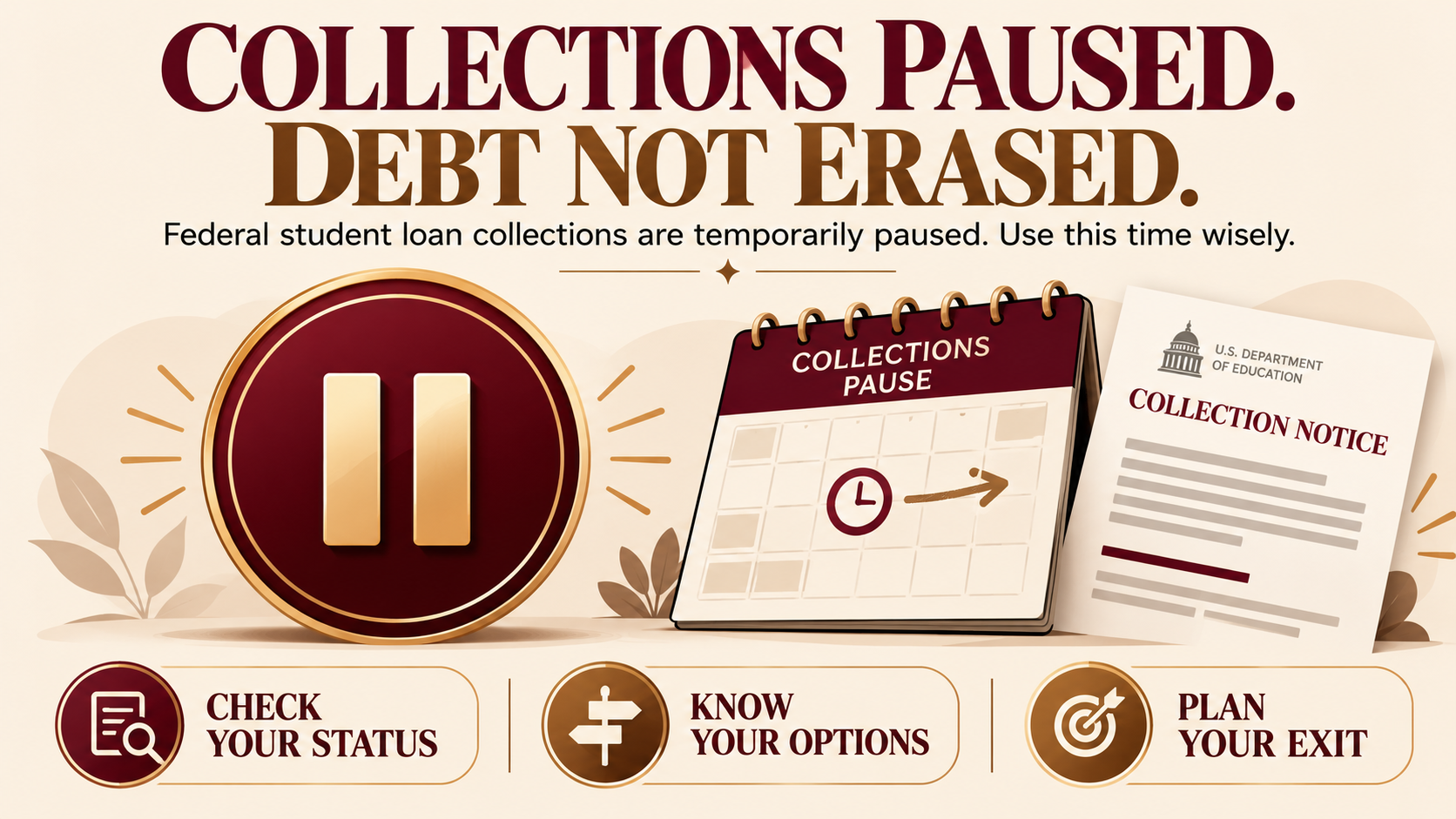
Yes. As of October 25, 2026, federal student loan collections through Treasury offsets and administrative wage garnishment remain temporarily paused. However, the pause does not eliminate your debt, remove a default, or prevent negative credit reporting. If your federal student loans are in default, this is an opportunity to review your loan status, evaluate rehabilitation or consolidation, and establish a path back to repayment before involuntary collections resume.
Here's what makes this situation particularly concerning. Some borrowers may assume that because the government isn't currently taking money from their paychecks or tax refunds, their student loans are no longer an immediate financial concern.
But the pause is temporary, and the consequences of default haven't disappeared.
For someone already managing a mortgage, household expenses, other debt, and retirement contributions, having money unexpectedly redirected toward a defaulted student loan could seriously disrupt an otherwise manageable financial situation.
The pause gives you time to address the problem. It doesn't make the problem go away.
What Is Actually Paused With Federal Student Loan Collections in 2026?
On January 16, 2026, the U.S. Department of Education announced a temporary delay in involuntary collections on defaulted federal student loans. The announcement specifically covered two collection methods: Administrative Wage Garnishment and the Treasury Offset Program.
Administrative Wage Garnishment allows the government to require an employer to withhold up to 15% of a borrower's disposable pay to collect a defaulted federal student loan. Treasury offsets can redirect certain federal payments, including tax refunds and eligible federal benefits, toward the outstanding debt.
The Department's decision temporarily suspended these collection methods while federal student loan repayment changes were being implemented.
Source: U.S. Department of Education: January 16, 2026, Collections Announcement
According to Federal Student Aid's current collections guidance, Treasury offsets and administrative wage garnishment remain paused as of this article's update date.
However, borrowers should understand what the announcement does not say.
It doesn't eliminate outstanding balances, automatically bring loans out of default, or erase previous delinquency. The Department of Education also continues reporting defaulted loans to credit reporting agencies, which can affect a borrower's ability to qualify for financing or obtain favorable credit terms.
There is currently no confirmed federal restart date for the paused collection methods. That uncertainty makes it especially important to understand your options rather than assuming another announcement will provide enough time to prepare.
Why Waiting Until Collections Resume Could Be Expensive
Imagine earning $150,000 a year and having most of your monthly financial obligations comfortably covered.
Your mortgage is manageable. You're contributing to retirement, maintaining your lifestyle, and perhaps even putting additional money aside each month.
Now imagine receiving notice that part of your paycheck could be withheld because of a student loan that went into default.
The issue isn't necessarily whether you earn enough money to repay the loan. It's what happens when a financial obligation you haven't been actively managing begins competing with money you've already committed elsewhere.
If your paycheck is supporting a mortgage, retirement contributions, insurance, family obligations, and other debt payments, an unexpected reduction in take-home income may require some difficult adjustments.
And the financial consequences can extend beyond cash flow.
According to Federal Student Aid's guidance on default and collections, unresolved defaults can result in damaged credit, collection costs, and the loss of certain federal student loan benefits.
That means a borrower could be experiencing financial consequences even while involuntary collections are temporarily paused.
The better question isn't simply whether collections have restarted. It's whether your current loan status could create a financial problem when they do.
First, Find Out Whether Your Student Loans Are Delinquent or in Default
Before evaluating a repayment strategy, it helps to understand where your loans actually stand.
A federal student loan generally becomes delinquent when a required payment is missed. For most federal student loans with monthly payments, default typically occurs after at least 270 days without the required payments.
Those are two different situations, and they can lead to different options.
If your loans are delinquent but not yet in default, you may still be able to work directly with your regular loan servicer to explore repayment arrangements or other available relief.
If your loans have already entered default, the process becomes more complicated because certain repayment benefits are no longer available until the default is resolved.
Federal Student Aid recommends logging into your account at StudentAid.gov to review your loan details, including balances, loan types, servicing information, and default status.
For borrowers whose loans are already in default, those details are particularly important because not every loan qualifies for the same resolution options.
Consider a 53-Year-Old Professional Earning $150,000
Imagine a single woman who has spent most of her professional life building a successful career.
She's 53, earns $150,000 annually, and has approximately $110,000 in federal student loans from undergraduate and graduate school.
Several years ago, she experienced a period of financial disruption while caring for an aging parent. Her student loan payments fell behind, and eventually some of her loans entered default.
Her income has since recovered, but the student loan situation remains unresolved.
When she hears that federal student loan collections are paused, she feels some relief. With her current responsibilities, the last thing she wants is another financial obligation competing for her monthly cash flow.
But there is something she may not be considering.
She's also beginning to think seriously about retirement.
If she wants to retire in 10 or 12 years, she has several financial decisions competing for her attention. Continuing to build retirement savings matters, but so does determining whether her student loans will still be part of her financial life when she stops working.
If involuntary collections resume before she resolves the default, she could experience additional pressure on her current income. And if she waits until retirement to address the debt, she may find herself making significant loan payments after her employment income ends.
Her challenge isn't simply that she owes $110,000. It's that she doesn't yet have a clear strategy for resolving the obligation.
This is why a temporary pause may be valuable. It creates an opportunity to evaluate the available options before another financial decision is forced upon her.
This is a hypothetical example for educational purposes.
What Are Your Options for Getting Federal Student Loans Out of Default?
This is where the conversation becomes more productive.
The question is no longer whether you should be worried about collections. It's which available strategy could help you resolve the default while supporting your broader financial goals.
Federal Student Aid identifies several possible approaches, including rehabilitation, consolidation, repayment agreements, and paying the balance in full. Some borrowers may also qualify for a loan discharge.
The appropriate choice depends on your loan type, current status, repayment history, and financial circumstances.
Option 1: Federal Student Loan Rehabilitation
Loan rehabilitation is a process designed to bring an eligible defaulted federal student loan back into good standing.
For Direct Loans and Federal Family Education Loan (FFEL) Program loans, rehabilitation generally requires nine qualifying voluntary payments within a 10-month period under an approved agreement.
Once rehabilitation is successfully completed, the loan is removed from default and the borrower regains access to certain federal student loan benefits.
There is also an important credit-reporting distinction.
Successful rehabilitation can result in the removal of the default record from a borrower's credit history, although previously reported late payments may remain.
That could make rehabilitation worth examining for someone who wants to address both the loan status and the credit consequences of default.
However, rehabilitation takes time. Beginning the process does not necessarily stop collections immediately once they resume.
Source: Federal Student Aid: Student Loan Rehabilitation FAQs
Option 2: Federal Student Loan Consolidation
For some borrowers, consolidation may provide a faster way to resolve default.
A qualifying defaulted federal student loan may be consolidated into a new Direct Consolidation Loan, subject to applicable requirements.
The new consolidation loan replaces the existing eligible loans, and the borrower can regain access to certain repayment options.
There are trade-offs, however.
Consolidation can increase the amount owed when outstanding interest or applicable collection costs are included in the new loan. It also generally does not remove the previous default from the borrower's credit history.
That makes consolidation and rehabilitation different strategies, even though both can ultimately help an eligible borrower move out of default.
The goal is to evaluate which outcome matters most for your situation rather than automatically choosing whichever process appears fastest.
Source: Federal Student Aid: Getting Out of Default
Option 3: Establish a Repayment Agreement
For some borrowers, entering into an approved repayment agreement with the loan holder may provide a way to address defaulted debt and prevent certain collection actions while the agreement's requirements are satisfied.
Federal Student Aid explains that repayment agreements can help borrowers avoid wage garnishment or Treasury offsets when applicable notice deadlines and payment conditions are met.
However, entering into a repayment agreement does not necessarily remove the default from your credit history or resolve the default in the same way that successful rehabilitation or consolidation does.
That distinction matters because the immediate objective of preventing collections may not be the same as the longer-term objective of restoring your loan to good standing.
Source: Federal Student Aid: Default and Collections FAQs
A New Federal Student Loan Default Portal Is Available
There is an important update that may make taking action more convenient.
On September 30, 2026, the U.S. Department of Education and U.S. Department of the Treasury announced the launch of a new Defaulted Loans Support Center.
The online portal allows borrowers with defaulted federal student loans to review their options and begin certain resolution processes without relying entirely on older paper-based procedures.
Through the center, eligible borrowers can compare rehabilitation and consolidation options, submit applications, make payments, and access information about repayment plans and loan discharges.
For borrowers considering rehabilitation, the new process can also allow documents to be uploaded and agreements to be signed electronically.
Source: U.S. Department of Education: September 30, 2026, Defaulted Loans Support Center Announcement
The official portal is available at StudentAid.gov/default-support.
Having a more convenient application process doesn't mean every loan can be resolved immediately, but it may remove some of the administrative barriers that previously made the process more difficult.
What If You Qualify for Student Loan Forgiveness?
This is where I would be particularly careful about making large payments without first understanding the broader situation.
Some borrowers may be eligible for federal student loan forgiveness or discharge programs that could significantly change their repayment strategy.
For example, federal employees and certain other public-service workers may qualify for Public Service Loan Forgiveness (PSLF) after satisfying the program's requirements, including 120 qualifying monthly payments.
But there is a catch for borrowers in default.
Payments made while a loan is in default, including loan rehabilitation payments, do not count toward PSLF.
That means a borrower who has worked for a qualifying employer may still need to resolve the default before future payments can qualify for forgiveness. Prior qualifying payment history should also be carefully reviewed before consolidation because consolidation can affect payment counts.
Federal Student Aid explains these requirements in its Public Service Loan Forgiveness FAQs.
For a professional approaching retirement, knowing whether forgiveness is a realistic option could significantly affect whether accelerating repayment is appropriate.
The important point is that getting out of default and deciding how to repay the remaining balance are two related but separate decisions.
What About the New Repayment Plans Available in 2026?
Federal student loan repayment rules have changed significantly in 2026, including the introduction of the Repayment Assistance Plan, commonly called RAP.
However, defaulted loans are not eligible for income-driven repayment plans while they remain in default.
Once an eligible borrower resolves the default, additional repayment options may become available. The specific choices depend on factors such as loan type, disbursement dates, and consolidation history.
According to Federal Student Aid's current income-driven repayment guidance, borrowers should review which plans are actually available for their loans rather than assuming that a particular repayment plan automatically applies.
For someone carrying a substantial student loan balance, the monthly payment is only part of the calculation. The projected repayment timeline, total interest cost, eligibility for forgiveness, and relationship to retirement goals also deserve attention.
A lower required payment may improve current cash flow, but it doesn't necessarily mean the borrower is moving toward the most appropriate long-term outcome.
What If You Have Already Received a Collection Notice?
If you've received an official collection notice, the timing of your response matters.
Federal Student Aid explains that borrowers may have specific rights to challenge a debt or request a hearing concerning proposed collection actions.
For example, administrative wage garnishment and Treasury offset notices can involve different response deadlines. Some hearing requests must be submitted within 30 days, while Treasury offset disputes may involve a 65-day period.
These deadlines depend on the type of notice and the circumstances involved, so the actual notice and current federal instructions should guide the response.
The temporary collections pause should not be interpreted as permission to ignore official correspondence.
Source: Federal Student Aid: Borrower Rights and Defaulted Loan Collections
If the amount is disputed, the loan status appears incorrect, or a garnishment notice has already been issued, reviewing the available administrative or legal options promptly may be particularly important.
What This Means for You
If you earn six figures and have federal student loans in default, the current pause may be giving you something more valuable than temporary relief.
It's giving you an opportunity to make a decision while you still have some flexibility.
You may be able to determine whether rehabilitation or consolidation is appropriate, investigate potential forgiveness opportunities, or establish a more manageable repayment strategy before involuntary collections resume.
For someone in her 40s or 50s, that decision can become particularly important because the time available before retirement is getting shorter.
You may already be contributing to retirement, paying down a mortgage, supporting family members, and working toward other financial goals. Allowing an unresolved student loan obligation to remain in the background could complicate those priorities later.
That is why I would encourage you to look beyond whether the government is currently collecting the debt and consider how the entire obligation fits into your financial future.
A pause in collections is not the same thing as a plan for getting out of debt.
And the longer a significant obligation remains unresolved, the more important it becomes to understand what options are still available.
Your Next Step: Understand Your Student Loan Exit Options Before Collections Resume
If your federal student loans are in default, the immediate goal may be to understand how to restore them to good standing. But that is only the beginning of the conversation.
What happens after the default is resolved?
How much will your monthly payment be? How long will you be making those payments? Is forgiveness an option? And how will this obligation affect your other financial goals?
These are the questions worth exploring before choosing a strategy.
At Financially Awakened, the Student Loan Exit Plan is designed to help borrowers examine their student loan situation alongside their cash flow, debt obligations, and long-term financial priorities.
Instead of looking only at how much you owe, we explore where your current approach is leading and which options may be worth considering.
Because getting out of default and getting out of student loan debt are not necessarily the same thing.
The goal is to understand both.
KNOW YOUR STUDENT LOAN EXIT OPTIONS
Frequently Asked Questions
-
Yes. As of October 25, 2026, Federal Student Aid states that Treasury offsets and administrative wage garnishment for defaulted federal student loans remain temporarily paused. However, the pause does not eliminate loan balances, remove defaults, or stop negative credit reporting.
Borrowers should monitor Federal Student Aid's official collections page for updates because a future restart date has not been confirmed.
-
Yes.
The Treasury Offset Program generally allows certain federal payments, including federal income tax refunds, to be redirected toward eligible defaulted federal student loan debts.
Those collections are temporarily paused as of this article's update date, but the government's underlying collection authority remains.
-
No.
The federal student loan collections pause does not stop interest from accruing on defaulted loans. It temporarily delays involuntary collection actions such as wage garnishment and Treasury offsets, but your debt can continue growing during the pause. That means waiting until collections resume could leave you owing more than you do today, even if the government isn't currently collecting payments.
According to Federal Student Aid's Loan Servicing and Collection FAQs, interest continues to accrue when collection activity is stopped. You can review your outstanding principal and accrued interest through your account at StudentAid.gov.
-
The two main ways to get federal student loans out of default are loan rehabilitation and loan consolidation. Rehabilitation generally requires nine qualifying payments within 10 months for Direct Loans and FFEL loans. Once completed, the default is removed from your loan and the default record is removed from your credit history, although earlier late payments may remain.
Consolidation can resolve the default faster, but the previous default remains on your credit history, and unpaid interest is added to the new loan's principal. Paying the balance in full is another option.
The best choice depends on your loan type, financial circumstances, and whether restoring your credit history or resolving the default quickly is your greater priority.
Start by checking your loan status at StudentAid.gov and comparing your options through Federal Student Aid's official Getting Out of Default guide.
The important distinction: Making a payment arrangement is not necessarily the same as getting your loan out of default.
-
Not through Public Service Loan Forgiveness (PSLF) while your loans remain in default, but that doesn't mean you've permanently lost your opportunity. Eligible federal student loans can regain access to forgiveness programs after the default is successfully resolved through rehabilitation or consolidation.
If you work for the federal government or another qualifying public-service employer, this distinction is particularly important.
PSLF generally requires 120 qualifying monthly payments, but payments made while your loans are in default, including rehabilitation payments, do not count toward those 120 payments. According to Federal Student Aid's PSLF guidance, your loans must meet the program's eligibility requirements before qualifying payments can count.
Before making large payments or consolidating your loans, consider reviewing your employment history, existing PSLF payment credits, and loan types. Consolidation can affect how prior qualifying payments are credited, so understanding your current position matters.
Other federal forgiveness or discharge programs may have different eligibility requirements, and certain discharges may be available even when a loan is in default.
The important question isn't simply whether you qualify for forgiveness today. It's whether resolving your default could restore access to forgiveness benefits you've already spent years working toward.
-
No.
Waiting until collections resume could turn a manageable financial problem into one that directly affects your paycheck, tax refund, or other eligible federal payments. The temporary pause does not eliminate your default, and the government can resume involuntary collection activities when the pause ends.
According to Federal Student Aid's default and collections guidance, administrative wage garnishment can take up to 15% of your disposable pay, while Treasury offsets can redirect certain federal payments toward defaulted student loan debt. Unresolved defaults can also result in additional collection costs and continued damage to your credit.
There is another reason waiting may work against you. Loan rehabilitation generally requires nine qualifying payments within 10 months for Direct Loans and FFEL loans, meaning the process takes time. Consolidation may resolve a default faster, but unlike rehabilitation, it does not remove the default record from your credit history. Federal Student Aid explains both options and their trade-offs.
The current pause gives you an opportunity to review your loan status, determine which resolution option fits your circumstances, and begin addressing the default before collections restart.
The question isn't whether you can afford to deal with your student loans today. It's what waiting could cost you when the government starts collecting again.
About Lisa Y. Jones
Lisa Y. Jones is a wealth strategist, financial educator and #1 best-selling author of Financial Seasons. Through Financially Awakened, she helps high-income professionals understand how cash flow, debt and financial decisions work together so they can move from earning good money to actually controlling more of it.
Disclaimer: This article is provided for educational purposes only and does not constitute individualized financial, tax, or legal advice. Lisa Y. Jones and Financially Awakened are not affiliated with or endorsed by the U.S. Department of Education or Federal Student Aid. Federal student loan policies and collection procedures are subject to change. Borrowers should verify current requirements directly with Federal Student Aid or their loan holder before making decisions.